DVBDefVetBridge Donate
For Australian veterans and their advocates

Your records already hold the evidence. DVB helps you find it.

DefVetBridge reads a veteran's medical and service records, matches what it finds to the DVA's Statements of Principles, and shows which factors have evidence on file and which are still missing. Then it builds a claim pack with every page cited back to the original document.

Built by a veteran going through the DVA claims process himself.

Example
Unit Medical CentreClinical notes
  1. 03 MAR 89Twisted R ankle on PT run. Swelling. Strapped, light duties 7/7.
  2. 21 JUN 90Annual medical. Fit for all duties.
  3. 14 FEB 91R ankle giving way since Mar 89 injury. Refer physio.
  4. 02 APR 91Physio: lateral ligament laxity R ankle.
E2Cited in the claim pack, page 3 of the original record
Injury to the ankle before onsetEvidence on file
Current diagnosis from a doctorGap: needed
Why DVB exists

The evidence exists. It is buried.

A DVA claim succeeds or stalls on evidence: proof that something happened during service and that it is linked to the condition you have now. That proof is usually in your own records, spread across hundreds of pages written decades ago.

Graham Kissell, a former ADF member in Brisbane, hit this wall with his own claim. The evidence was in his files, but finding the right lines by hand meant days of reading. So he built DefVetBridge to do the finding, and to set out the result so an advocate and the DVA can check it.
Built from real use

DVB was built on real records, starting with Graham's own. It is now in use with a second veteran, and their first claim packs are being reviewed line by line.

It is self-funded, with no company or government money behind it.

370+

Statements of Principles

Each condition has its own list of factors the DVA looks for. Picking the wrong one means checking the wrong evidence.

100s

of pages per veteran

Medical files, service records, specialist letters and scans. Much of it handwritten, abbreviated and out of order.

1

line can matter

A single entry from 1991 can be the link a claim needs. Finding it by hand takes days, if it is found at all.

What it does

Everything between your records and a claim

Read

Reads typed and handwritten records

Scanned medical notes, service records and specialist letters, including handwriting that ordinary text search misses.

Find

Finds conditions, dates and injuries

Pulls out each condition, when it was first recorded, which side of the body, and who treated it.

Group

Groups records into injuries

Fifteen notes about one shoulder become one shoulder injury, so nothing is counted twice or missed.

Match

Matches to the right SOP

Each condition is matched to its Statement of Principles, so the evidence is checked against the factors that actually apply.

Check

Shows evidence and gaps

For every factor: the pages that support it, or a clear note that nothing on file does yet.

Build

Builds the claim pack

Pre-filled DVA forms and the cited pages in one PDF, ready for you and your advocate to check.

How it works

From a box of records to a claim pack

You stay in charge at every step. DVB does the reading and sorting; you and your advocate make the decisions.

  1. Upload your records

    PDFs, scans and photos of your medical and service records, as they are.

  2. DVB reads every page

    Typed and handwritten notes are read and indexed, with conditions, dates, injuries and treating doctors pulled out.

  3. You check the matches

    See each condition's Statement of Principles, which factors have evidence, and which are gaps. Accept or reject what DVB found.

  4. Build and lodge

    Build the claim pack, review it with your advocate, then lodge it with the DVA yourselves.

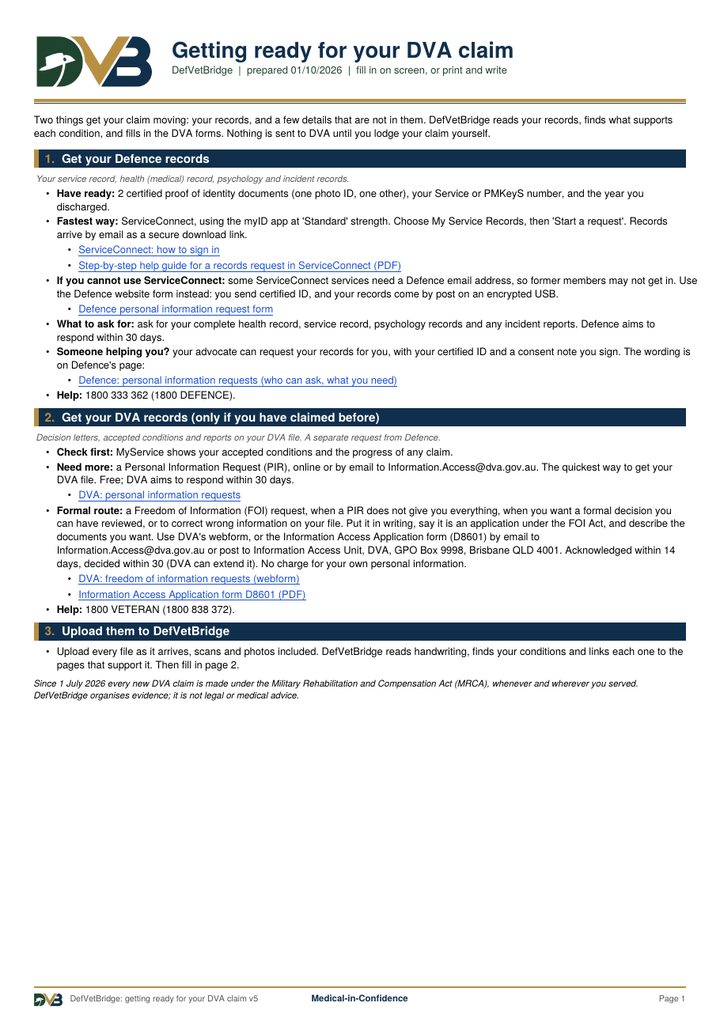
First page of the guide: Getting ready for your DVA claim
Free guide, for any veteran

Getting ready for your DVA claim

Most of a claim comes from your records, and getting them is the first hold-up. This two-page guide shows you how to get them and what else to have ready. It is useful whether or not you use DVB.

  • 1Your Defence records. What to ask for, the fastest way to request them through ServiceConnect, and the Defence form to use if you cannot sign in.
  • 2Your DVA file, if you have claimed before. Where to see your accepted conditions, and how to ask for the rest with a free information request.
  • 3The details your records don't hold. A one-page form for contact details, next of kin, GP, advocate and accepted conditions. Fill it in on screen or print it.
Download the free guidePDF, 2 pages, fill in on screen or print
The work

Inside a claim pack

A claim pack is one PDF that puts the forms and the proof side by side. Every quote in it links to the exact page it came from, so an advocate or a DVA delegate can check it in seconds.

A real pack built for one knee claim ran to 188 pages, with every cited line highlighted and linked back to its source document.

  1. CoverContentsEach claim, what it covers, and how strong its evidence is.
  2. FormsDVA forms, pre-filledYour details, service and injury dates, ready to check and sign.
  3. IndexEvidence indexEach Statement of Principles factor and the quote that supports it.
  4. E1–E12Cited pagesThe original pages, with the relevant lines highlighted.
  5. A1–A9AppendixEach source document in full, so nothing is taken out of context.
Questions

What DVB is, and what it is not

Does DVB lodge my claim for me?

No. DVB builds the claim pack. You, or your advocate, check it and lodge it with the DVA yourselves. Nothing is ever sent to the DVA automatically.

Will it tell me whether my claim will succeed?

No. DVB shows what your records support and where the gaps are. It never gives odds of success, because only the DVA decides a claim.

Is it legal or medical advice?

No. DVB organises evidence. It works alongside your advocate and your doctor, not instead of them. It never fills in the parts of a form that only a doctor can complete.

Who can see my records?

Only you, and an advocate you choose to give access to. Each veteran's records are kept separate at the database level, and nothing is deleted without a record of what was removed.

Is there anything I can do now, before DVB is open?

Yes. Start gathering your records. The free guide shows how to request your Defence and DVA records and what other details to have ready. Records can take around 30 days to arrive, so it is worth starting early.

Can I use DVB now?

Not yet. DVB is working with its first veterans and the first real claim packs are being reviewed. Donations help open it to more veterans and advocates sooner.

Is DefVetBridge part of the DVA or Defence?

No. It is an independent project built by a veteran. It is not part of, or endorsed by, the Department of Veterans' Affairs or the Department of Defence.

Next step

Help get DVB finished

A donation of any size goes into reading more veterans' records. If you know a veteran or an advocate who should hear about DVB, share this page with them.

Donate with PayPal